Showing posts with label gear tooth failure. Show all posts

Gear tooth failure

Machine Design

Gear Drive
Introduction:
There are different modes of failure of gear teeth and their possible remedies to avoid the failure.

Causes of Gear Tooth Failure
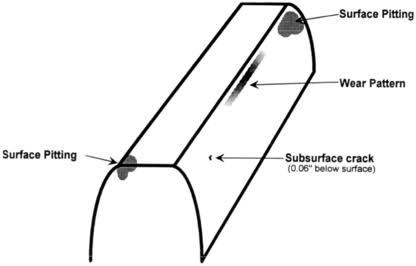

1. Bending failure.

  • Every gear tooth acts as a cantilever.
  • If the total repetitive dynamic load acting on the gear tooth is greater than the beam strength of the gear tooth, then the gear tooth will fail in bending, i.e. the gear tooth will break.
  • In order to avoid such failure, the module and face width of the gear is adjusted so that the beam strength is greater than the dynamic load.

2. Pitting.

  • It is the surface fatigue failure which occurs due to many repetition of Hertz contact stresses.
  • The failure occurs when the surface contact stresses are higher than the endurance limit of the material.
  • The failure starts with the formation of pits which continue to grow resulting in the rupture of the tooth surface. In order to avoid the pitting, the dynamic load between the gear tooth should be less than the wear strength of the gear tooth.

3. Scoring.

  • The excessive heat is generated when there is an excessive surface pressure, high speed or supply of lubricant fails. It is a stick-slip phenomenon in which alternate shearing and welding takes place rapidly at high spots.
  • This type of failure can be avoided by properly designing the parameters such as speed, pressure and proper flow of the lubricant, so that the temperature at the rubbing faces is within the permissible limits.

4. Abrasive wear.

  • The foreign particles in the lubricants such as dirt, dust or burr enter between the tooth and damage the form of tooth.
  • This type of failure can be avoided by providing filters for the lubricating oil or by using high viscosity lubricant oil which enables the formation of thicker oil film and hence permits easy passage of such particles without damaging the gear surface.

5. Corrosive wear.

  • The corrosion of the tooth surfaces is mainly caused due to the presence of corrosive elements such as additives present in the lubricating oils.
  • In order to avoid this type of wear, proper anti-corrosive additives should be used.

Machine Design ( Gear Drive) (9)


Machine Design

Gear Drive


Law Of Gearing : The law of gearing states that " the common normal to the tooth profile at the point of contact should always pass through a fixed point called pitch point in order to get constant velocity ratio."


Gear Tooth Failures :
There are two basic modes of gear tooth failure : 

(a) Breakage of tooth due to static and dynamic loads. 
(b) Surface destruction. 

The complete breakage of the tooth can be avoided by adjusting the module and face width, so that the beam strength of the gear tooth is more than the sum of static and dynamic load. 

The surface destruction or tooth wear is classified as follows : 

(i) Abrasive wear : Foreign particles such as dirt, rust etc. can scratch the tooth surface. Remedies against this type of wear or provision of oil filters, increasing surface hardness and use of high viscosity oils. 

(ii) Corrosive wear : The corrosion of the tooth surface is caused by corrosive elements such as extreme pressure additives present in the lubricating oils and foreign materials due to external contamination. These elements attack the tooth surface, resulting in fine wear uniformly distributed over the entire surface. 

(iii) Initial pitting : The initial pitting is a localized phenomenon characterized by small pits at high spots. Initial pitting is caused by the errors in the tooth profile, surface irregulation and misalignment. The remedies against initial pitting are precise matching of gears, adjusting the correct alignment of gears so that the load is uniformly distributed. 

(iv) Destructive pitting : Destructive pitting is a surface fatigue failure which occurs when the load on the gear teeth exceeds the surface endurance strength of the material. This type of failure can be avoided by designing the gear in such a way that the wear strength of the gear tooth is more than the sum of static and dynamic load. 

(v) Scoring: Exclusive surface pressure, high surface speed and in adequate supply of lubrication result in the breakdown of the oil film. This results in excessive frictional heat and overheating of meshing teeth. It can be avoided by selecting the parameters such as surface speed, surface pressure and the flow of lubricant in such a way that the resulting temperature at the contacting surfaces is within permissible limit. 


Mechanicallec

PLCP Quiz

 Which of the following governance level represents monthly SLA review ? Steering committee Engagement management committee Requirement Engi...